
TL;DR:
What’s the problem?
A due diligence report mixes the researcher’s own judgment with facts taken from source documents. During an audit, reviewers need to know which lines a person verified and how well each claim is backed. General AI assistants show neither, and fixing one sentence regenerates the whole section.
Whats the solution
RateSense adds a trust and transparency layer to AI drafting. Every paragraph is labeled as written by AI or by a researcher. Each claim links to the exact page it came from, with a confidence score based on how many sources back it and how reliable they are. Researchers rewrite only the sentence they select.
My Contribution
Discovery workshops with 15 SMEs.
Synthesized findings into a future-state service map unifying 3 fragmented legacy platforms and where AI could take over.
Partnered with 3 Gen-AI Engineers
to design 5 human-in-the-loop features behind the AI-Report creation: Attribution, citations, & confidence scoring.
Design & Shipped 2 end-to-end flows
Designed and Demoed the platform to senior leadership, including global managers, SMEs to secure buy-in for broader rollout
A peak into my Design file: Here’s what & how I shipped this project!
The Problem
Lack of Verifiability
Researchers had little to no trust because a single unverified A.I generated claim isn’t an inconvenience. It’s a compliance risk!

This is an example from a well-known app
Invisible authorship
Finished report reads as one voice, with nothing on the page showing weather something is written by A.I or human. Which matters most during an audit.
by AI?

by a Researcher??
Lack of control
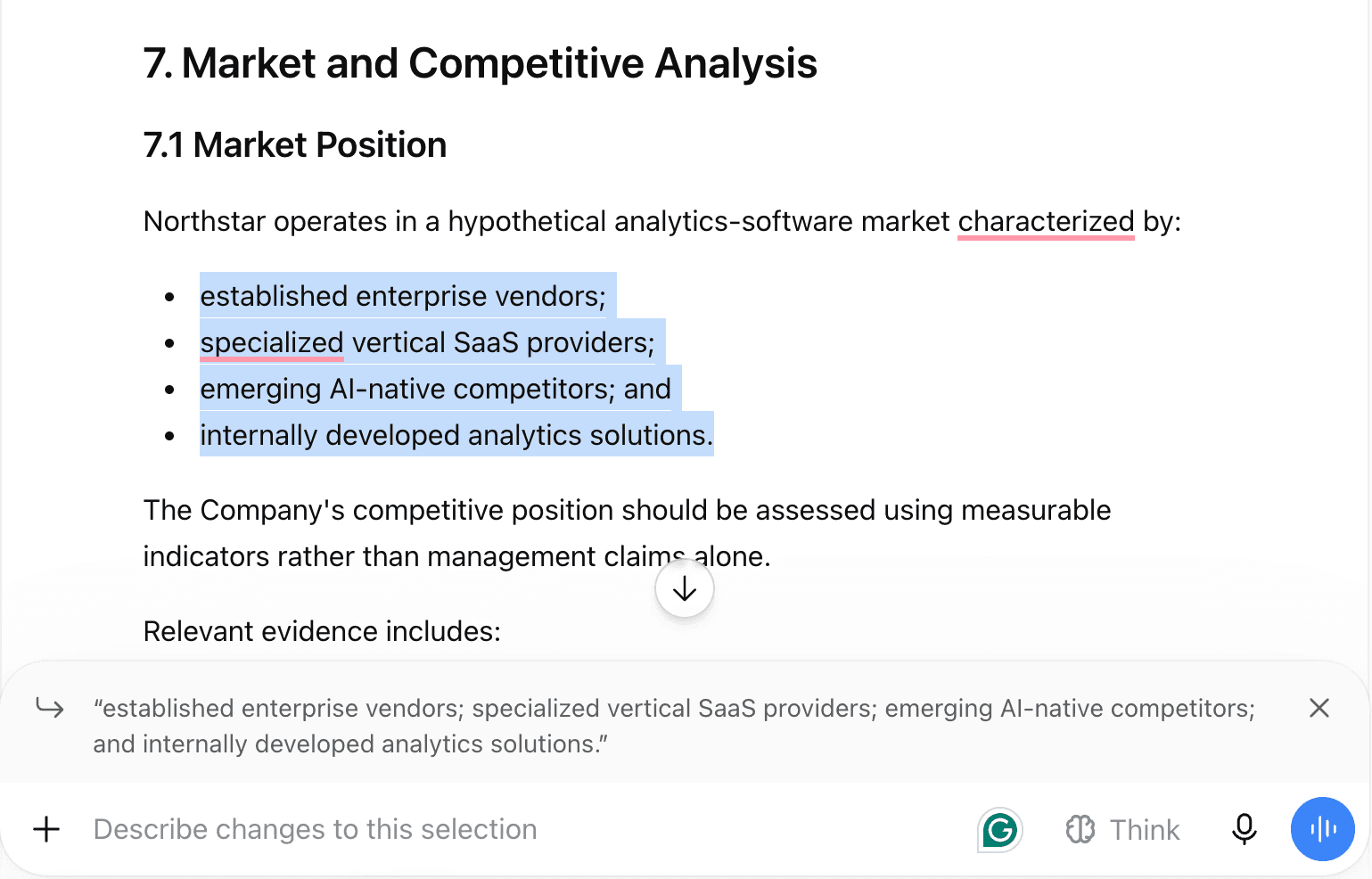
ChatGPT, Claude etc. are general-purpose AI assistants, Not made for iterative workflows. Researchers were stuck switching between A.I and word just to improve content for a portion of the report
The Solution
Unifying 3 disconnected platforms into an AI-assisted workflow. Every source gets pulled into Source library, and a report can be generated directly into Marsh’s standard template
Play
Play
Inspect Mode and Citations
Clicking into Inspect Mode surfaces all the meta-data behind a claim, along with a citation, confidence score covering language, tone, and how reliable that source actually is.
How this solves the problem
This gives a compliance reviewer exactly what the invisible authorship problem was missing: a clear, immediate answer to who wrote a given line.
Attribution
Hovering over any line shows whether AI wrote it or a person did. The distinction that used to be invisible across the whole report is now visible one hover at a time.
How this solves the problem
This adds a trust and transparency layer on top of the report. A claim is never just asserted, All the metadata is shown
Play
Inline editing and versioning
Iterate the AI-generated content without losing context generate multiple versions of the reports
Play
Select any part of the report, give it a quick instruction, and it updates in place. No full reprompt required.
Play
Lock a section and then regenerate the rest of the report from new documents without touching what is already approved.
